
How I learned to also watch the last ten minutes of a nature documentary
Written by Mérijn Stam
As a child I enjoyed documentaries about the life of animals, in the sea or elsewhere. Yet in the last ten minutes I often zapped to something else. The moment in the documentary where the makers showed the impact of humans on the living environment of the nature and animals in question. The end of the films I enjoyed so much was always negative. I felt guilty about it and often couldn't watch it. Why do humans do that? You don't do that, right?! I couldn't wrap my head around it.
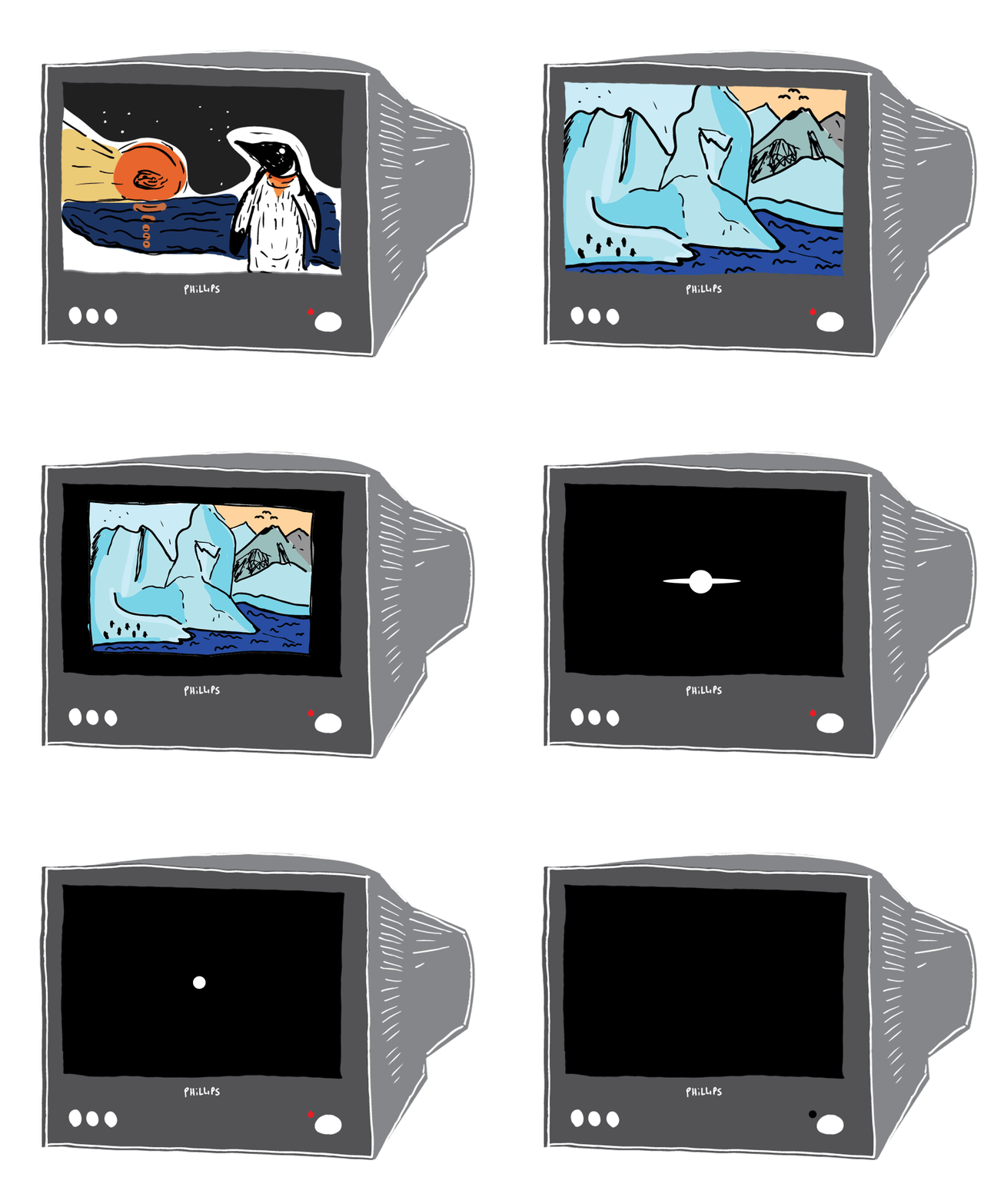
Yet when I got older I didn't think much about the impact of my behavior on the environment. I just consumed, like everyone around me. Just about every month I flew around the world for my work and many impulse purchases were in my name. Just, living the good life. Right?
That guilt I used to have as a little boy during the last minutes of my beloved documentaries reared its head again. The years flew by – years in which I could skate less and less often on my birthday in February. The guilt grew and grew. I reached the peak after the birth of my children. I thought to myself: Is this how we want to leave things behind?
I gained more insight into my own behavior and its consequences. They felt heavier. My moral sense was working overtime. There are so many others who also just live a good life, so much has to happen to change this behavior. What can I do? How can I change even anything, besides recycling and taking shorter showers? I could bombard my friends with even more unsolicited advice, but they see me coming. Politics then? No. Too abstract and too little ratio. Those inexplicable power games I was familiar with and already stumbled over? No, thanks.
There clearly arose a need to use my energy differently. Soon I found out that I want to experience satisfaction in work. Want to have a positive impact on society. This eventually brought me to the Future Design Playground, where I now work as a teacher and coordinator. A study program created together with Eric Voigt, Erik Prins and yours truly and hosted in the Blokhuispoort, right in the center of Leeuwarden. Together with students we work on the problems we face as a society. Such as biodiversity loss, drought, exhaustion of the earth by agriculture and overconsumption in the broadest sense of the word.
If we do nothing, the future happens to us
If we do nothing, the future happens to us. That is the most important starting point of our working method. An example of a probable future could be: Everyone works from home behind the PC, or our role as teacher is replaced by Holograms.
A desirable future could be: The whole school system merges into daily life. Learning to grow food yourself as a child by calculating how much water it needs and why. What you can do with it and when you have to take action again to harvest. This combines physical education, math, biology and planning. An important condition is that this happens in complete harmony with nature.
Pie in the sky? Maybe. But this is all possible if you look at beautiful initiatives that already exist and everything turns out to be technically possible already. Now 'just' other choices have to be made.
Compared to the normal way of innovating, this is, in our opinion, the only way to generate radical impact and work on the problems we are heading for in society. Because the current way of innovation is continuing to optimize the status quo and is going way too slowly. This must be a recognizable feeling, right?
So, now I'm going to work on a desirable future in which time travel will become reality…
… then I go back to that zapping boy to tell him to keep watching anyway because he will end up where he should be.
Mérijn Stam
As a teacher at CMD LWD I am in the place where I need to be. Together with students, teachers and industry partners we build innovation in the field of sustainability, future visions and new lifestyles. The creative inspiration that the industry partners and teachers gain is unprecedented. That mainly comes from the intrinsic motivation students have to work on their own chosen directions.